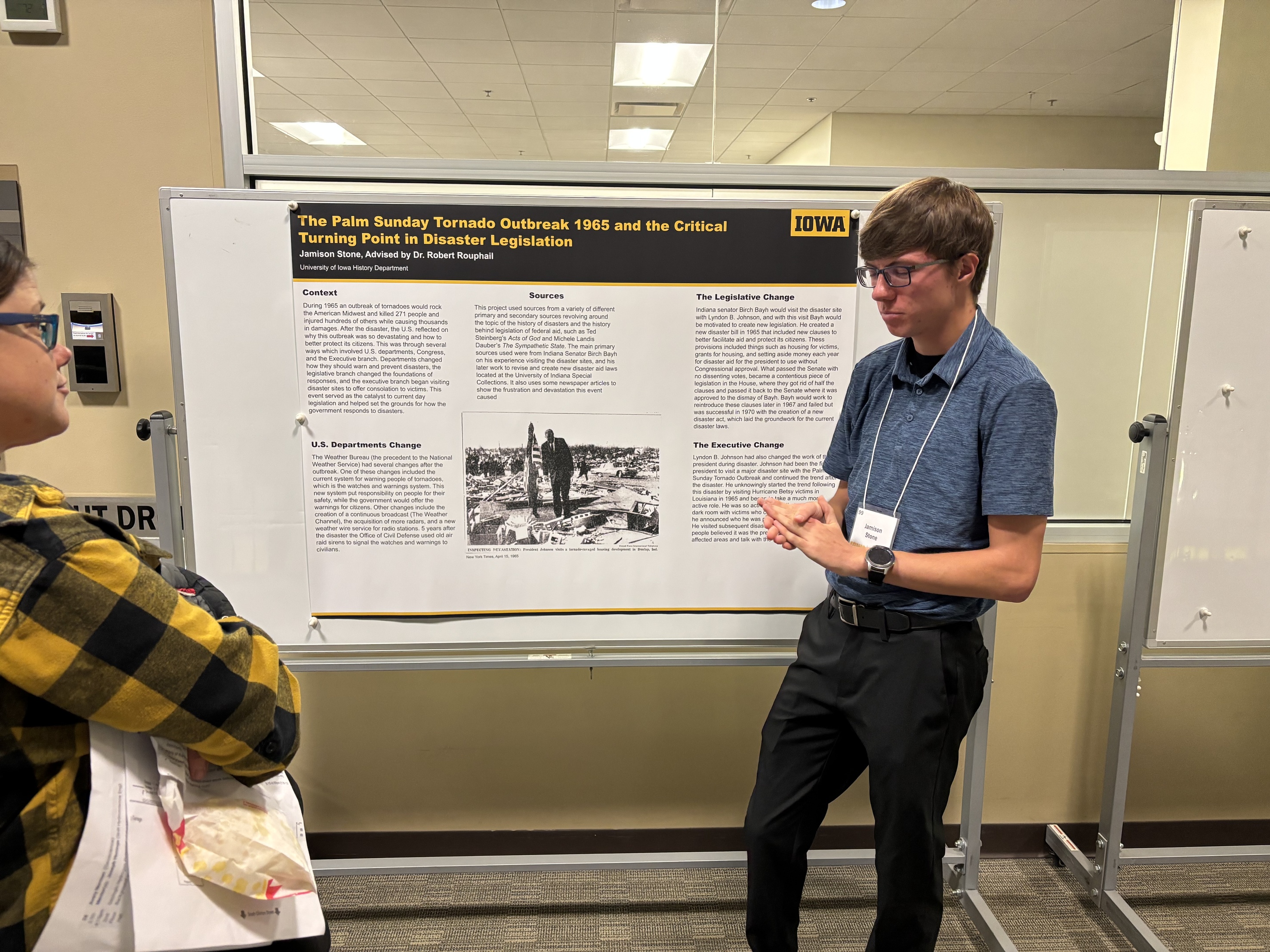
Jamison Stone, an undergraduate honors student, was selected as one of just 20 Iowa students to participate in the prestigious Research in the Capitol program—an annual event hosted by the University of Iowa’s Office of Undergraduate Research in partnership with Iowa State University (ISU) and the University of Northern Iowa (UNI). The program brings undergraduate researchers to the Iowa State Capitol to share their scholarly and creative work with state legislators and the public.
The students will travel to the Iowa Statehouse to talk to Iowa's legislators about research on Monday, March 9, 2026. This opportunity to practice presenting their research gives students exposure to legislators and policymakers who may influence funding or policy related to research. It's also a way to network with peers from the other Iowa Regent universities as an ambassador of
Jamison will be presenting his work, "Resilient Lawmaking: The Palm Sunday Tornado Outbreak of 1965 and the Critical Turning Point in Disaster Legislation."
His thesis argues that the Palm Sunday Tornado Outbreak in 1965 was a major turning point in how the government reacts to disasters. These tornadoes killed 271 people as they rampaged through the Midwest, with Indiana being the worst hit. The outbreak pushed President Lyndon B. Johnson to travel to the disaster-stricken area with representatives from Congress who worked for the areas affected. The trip was monumental: not only was it the first recorded time a president visited a larger disaster site, but it was the catalyst for Indiana senator Birch Bayh to introduce legislation to change disaster aid. Previously, disaster aid was given after every disaster but only at the behest of Congress. Congress would eventually pass the Stafford Act in 1988, which is in effect today. Prior to this from 1965 to 1970, Senator Bayh initiated and helped pass legislation that streamlined the process of aid distribution and gave the executive branch authority to speed up relief. This legislation would be the groundwork for the later Stafford Act. The tornado watches and warning system and invention of a continuous weather broadcast were also outcomes of this act. The thesis makes use of contemporary newspapers, journal articles, and various primary sources from the Bayh collection.